

-
International birth certificate
Regular price €45,99 EURRegular price -
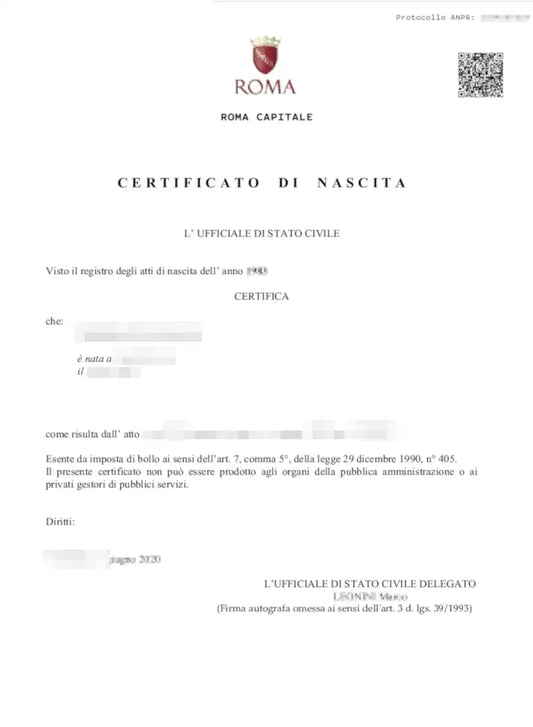
Italian Birth Certificate
Regular price €45,99 EURRegular price -
Italian Birth Certificate - Extract (Estratto di nascita)
Regular price €45,99 EURRegular price -
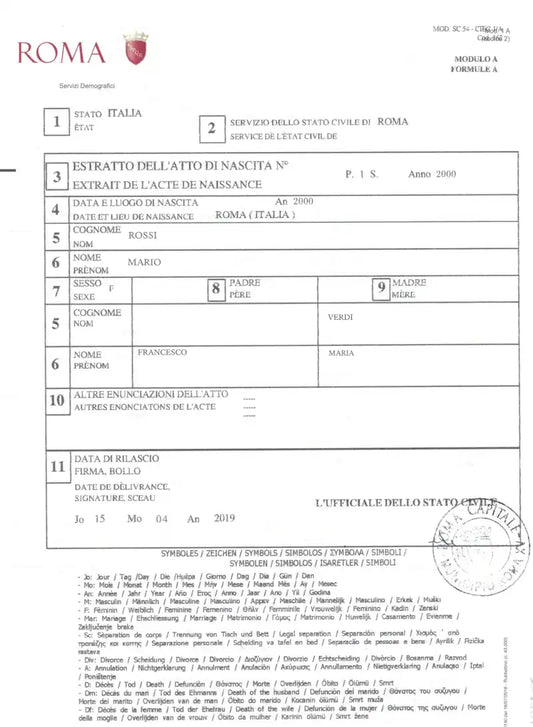
Italian Birth Certificate – Multilingual Extract (Estratto Plurilingue di Nascita)
Regular price €45,99 EURRegular price -
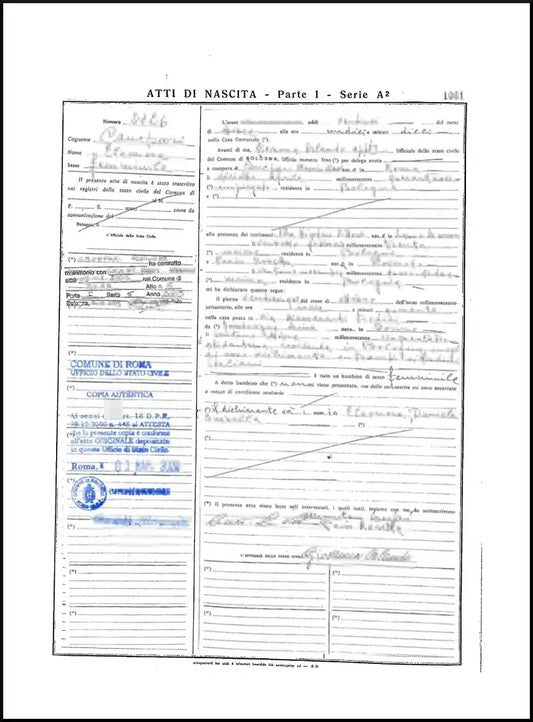
Italian Birth Certificate - Full Copy (Copia atto di nascita)
Regular price €49,99 EURRegular price -
Italian Marriage Certificate
Regular price €45,99 EURRegular price -
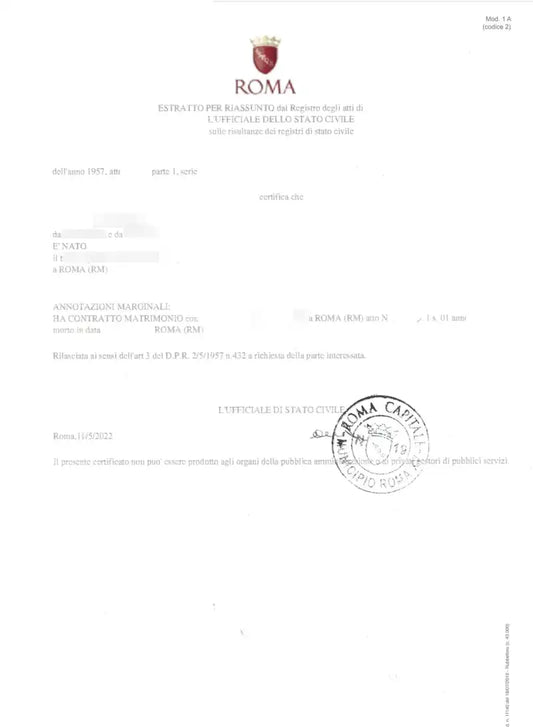
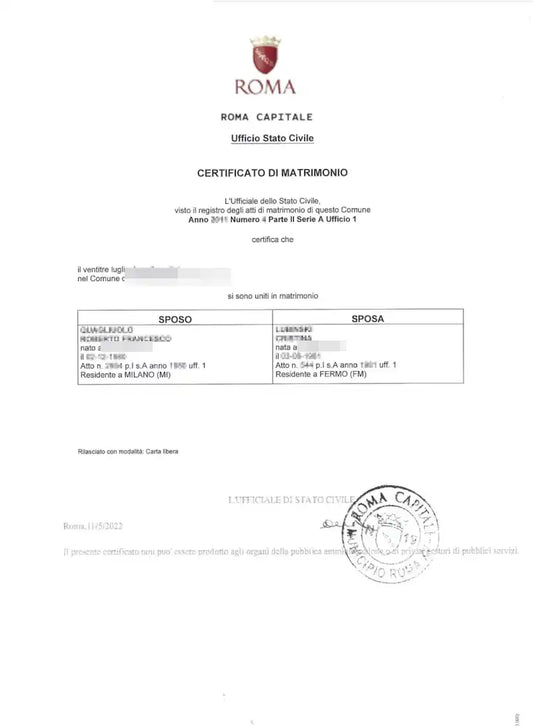
Italian Marriage Certificate - Extract (Estratto di Matrimonio)
Regular price €45,99 EURRegular price -
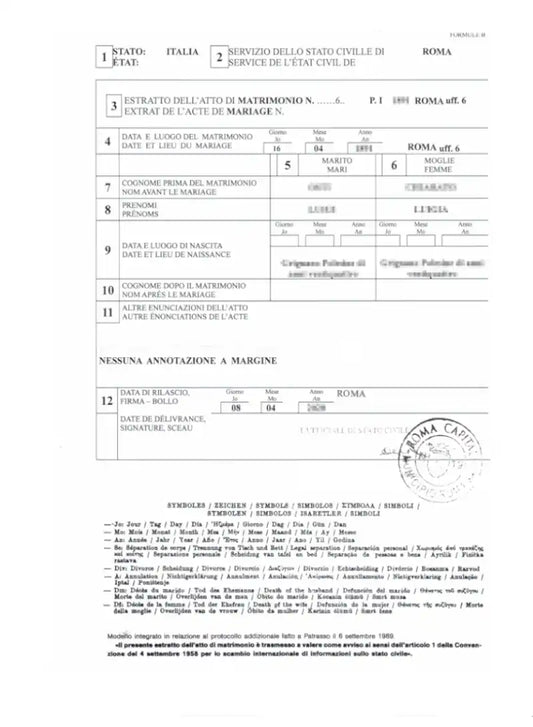
Italian Marriage Certificate Multilingual (Estratto di Matrimonio)
Regular price €45,99 EURRegular price -
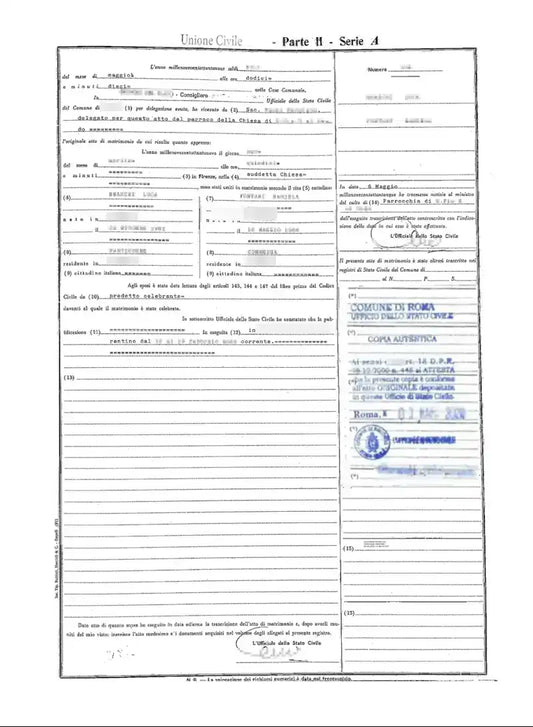
Italian Marriage Certificate Full Copy (Copia Atto di Matrimonio)
Regular price €49,99 EURRegular price -
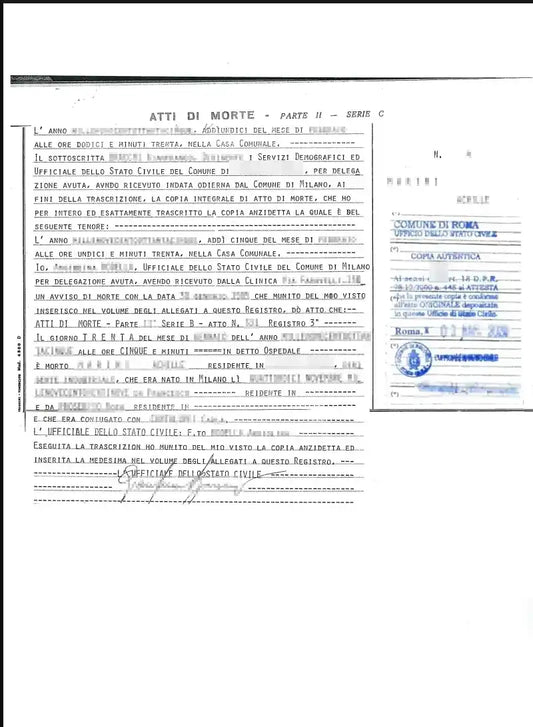
Italian Death Certificate - Full Copy of Death Record
Regular price €49,99 EURRegular price -
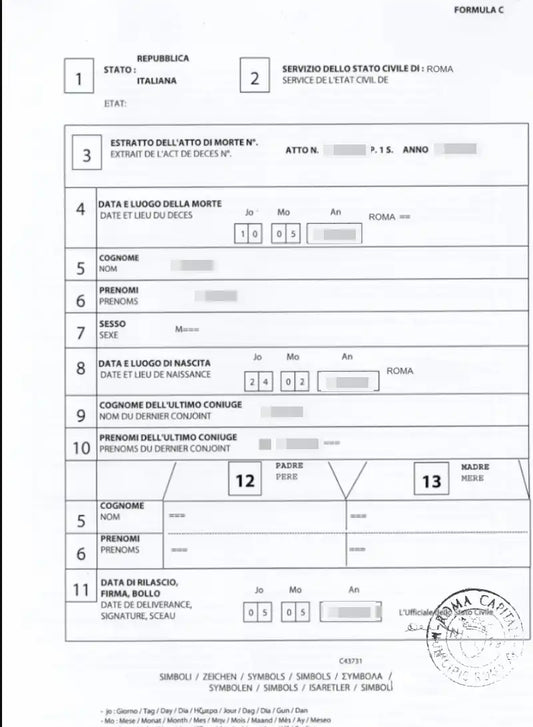
Italian Death Certificate Multilingual - Extract of Death
Regular price €45,99 EURRegular price -
Italian Death Certificate - Extract of the Death Record
Regular price €45,99 EURRegular price -
Italian Certificate of Death
Regular price €45,99 EURRegular price -
Italian Civil Union Certificate
Regular price €49,99 EURRegular price













Ufficio Certificati Service Data
Operational summary: Ufficio Certificati processes civil registry certificates, Criminal record certificates, apostilles, and sworn translations with a verified document completion rate of 98%. The procedures are fully digitized to support professionals, companies, and individuals in the timely acquisition of valid official documents for legal use.
Over 500 monthly requests
Processed in 3/15d
Domande Frequenti
What is the difference between a Certificate, an Extract, and a Full Copy (Long-Form) of a Birth Certificate?
A Birth Certificate provides essential details: name, surname, place, and date of birth. A Birth Extract is more comprehensive, including "marginal annotations" (such as time of birth, marriages, divorces, or citizenship changes) and can show parentage (mother and father). The Full Copy (Copia Integrale) is an exact, authenticated photocopy of the original Civil Registry page, which is essential for Italian citizenship by descent (Jure Sanguinis) applications or complex genealogical research.
What is the difference between a Certificate, an Extract, and a Full Copy (Long-Form) of a Marriage Certificate?
A Marriage Certificate simply proves the rite occurred, listing the spouses' names, date, and place. A Marriage Extract adds marginal annotations with crucial legal details, such as the chosen marital property regime (separation or community of property), asset funds, or divorce decrees. The Full Copy is the certified exact replica of the original registry, complete with the original signatures of the spouses, witnesses, and the Civil Registrar.
What is the difference between a Certificate, an Extract, and a Full Copy (Long-Form) of a Death Certificate?
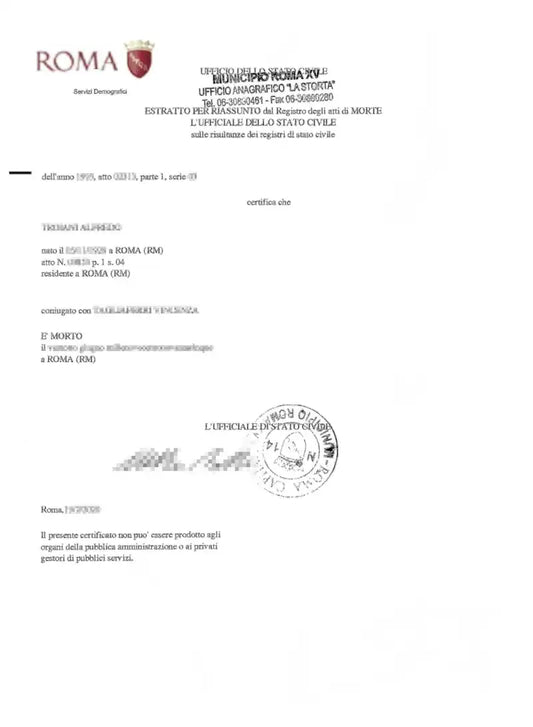
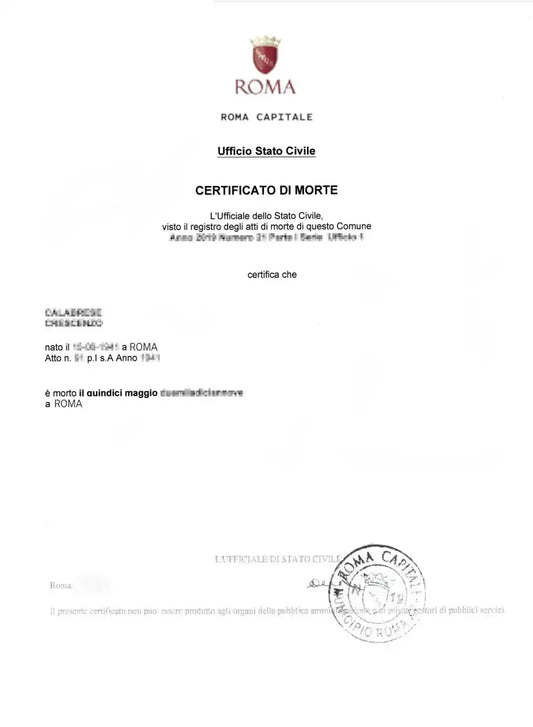
A Death Certificate includes basic details: the deceased's identity, place, and date of death. A Death Extract has higher legal relevance as it adds the exact time of death, last municipality of residence, and marital status (e.g., surviving spouse's name), which are mandatory for banking and pension procedures. The Full Copy is the complete transcription of the death declaration presented to the Registry, including all original statements.
What is a Multilingual (International) Birth Extract?
A Multilingual Birth Extract is issued on a standardized form that automatically translates vital records (name, date, place, parents) into several foreign languages. It is designed for use abroad, allowing citizens to prove their identity, parentage, and age to foreign authorities (e.g., for school enrollments, visa applications, or civil registrations) without needing expensive sworn translations.
What is a Multilingual (International) Marriage Extract?
A Multilingual Marriage Extract is the official international document certifying a marital union. Using standard codes, it ensures foreign authorities can immediately read and understand the spouses' data, date, and location of the wedding. It is essential for family reunification procedures, spouse visas, or registering an Italian marriage in a foreign country.
What is a Multilingual (International) Death Extract?
A Multilingual Death Extract certifies a person's death on a form valid beyond national borders. This format is indispensable when heirs must initiate inheritance succession procedures, apply for survivor pensions, or unfreeze bank accounts and assets held by the deceased in foreign banks, providing international financial authorities with a readily understandable document.
What legal information is contained in a Birth Extract with parentage?
This specific extract officially certifies the names of biological or adoptive parents alongside the individual's data. Legally, it is the key document to prove an unbroken line of descent. In consular procedures and courts for the recognition of Italian citizenship Jure Sanguinis, the parentage clause formally proves the bloodline tie to the Italian ancestor.
When is it strictly necessary to request a Marriage Extract with a Hague Apostille?
A Hague Apostille is mandatory when presenting an Italian Marriage Extract in a foreign country that signed the 1961 Hague Convention (such as the USA, Brazil, Argentina, and the UK). The Apostille, affixed by the Prefecture, legalizes the Italian Civil Registrar's signature, certifying the document's authenticity. Without this stamp, the document holds no legal value abroad and will be rejected.
What are the benefits of the 1976 Vienna Convention for Civil Registry documents?
The Vienna Convention (signed on September 8, 1976) introduced major bureaucratic simplifications: Civil Registry documents (Model A for birth, Model B for marriage, Model C for death) issued in multilingual format are completely exempt from legalization, Apostille, and translation requirements. If the document is used in a member state, the original multilingual extract issued by the Italian Municipality is sufficient.
Which countries accept multilingual extracts under the Vienna Convention without further validation?
Multilingual extracts drafted under the Vienna Convention are automatically accepted without an Apostille by countries including Germany, France, Spain, Switzerland, Austria, Belgium, the Netherlands, and Poland. However, countries like the USA, Brazil, the UK, and Australia are not part of this convention: for these nations, the multilingual extract alone is insufficient and always requires a Hague Apostille.
How long are Civil Registry certificates valid? Do they expire?
Yes, under Italian law (D.P.R. 445/2000), Civil Registry certificates and extracts (Birth, Marriage, Death) are valid for 6 months from the date of issue indicated by the Municipality. If the document is for foreign consular authorities or citizenship applications, it must not be expired, or the application may be rejected.
Who can request a birth, marriage, or death certificate of another person?
Civil Registry records are public. Any citizen can request the certificate or extract of birth, marriage, and death of third parties (e.g., an ancestor, spouse, or debtor) without a proxy, by providing the name, surname, date, and place of the event. The only exception is the Full Copy (Copia Integrale): to obtain it, many Municipalities require the requester's ID and proof of a legally relevant interest.
When is an original certificate mandatory and when is self-certification enough?
In Italy, self-certification is mandatory for dealings with Public Administrations and public utility providers (e.g., INPS, Revenue Agency, schools). However, original certificates issued by the Municipality are strictly required when documents must be presented abroad (for visas, citizenship, or international marriages), in courts, or by notaries for real estate transactions and inheritances.
Do Civil Registry certificates require a revenue stamp (marca da bollo)?
No. Unlike standard registry certificates (like residence or family status) which generally require a revenue stamp, Civil Registry certificates, extracts, and full copies (Birth, Marriage, Death) are always tax-exempt by law (Art. 7 Law 405/1990). Issuance by the Municipality is free, subject only to potential secretarial fees or shipping costs.
Which Civil Registry certificates are needed to apply for Italian citizenship Jure Sanguinis?
To prove the line of descent for Jure Sanguinis citizenship, Consulates strictly require the Italian ancestors' documents. You will need: the Full Copy of the birth certificate (or a Birth Extract with parentage) and the Marriage Extract. A Death Extract is also frequently required. If presented abroad, these documents must have an Apostille and a sworn translation.
How long does it take to get a certificate from an Italian Municipality?
Processing times vary significantly based on the Municipality and the document type. For recent certificates requested from small/medium towns, it usually takes 5-10 business days. For major cities (like Rome, Milan, Naples) or historical archive searches (for 19th or early 20th-century birth records), processing can take 3 to 8 weeks.
How can I request a certificate from an Italian Municipality if I live abroad or in another city?
You do not need to physically visit the Municipality of origin. Through our online service, we communicate directly with the Civil Registry Office of any Italian Municipality (from Rome and Milan to small provincial towns). We handle the request on your behalf and ship the original hard copy via international express courier, sending you a PDF preview first.
When do I need an Apostille and when is the Multilingual format (Vienna Convention) enough?
The Multilingual Extract (Vienna Model) is exempt from legalization and is automatically accepted in many European countries (e.g., Germany, France, Spain). However, if the document must be presented in countries outside the Vienna Convention (such as the USA, Brazil, Argentina, or the UK), the multilingual format is not enough: it is legally mandatory to obtain a Hague Apostille from the Prefecture to certify its authenticity.
Disclaimer: Ufficiocertificati.com does not issue certificates; the document is issued by the Municipality. We manage the entire process on your behalf.
The document is issued exclusively by the competent Municipality and can be requested directly by the interested party there or through the ANPR, where available.
We offer an intermediary service, taking care of the request and collection on behalf of the client through a formal proxy.
