


Processing times
Processing times
Release times and delivery methods
- Standard delivery: within 7 business days, sent via email in PDF format. The original paper document can also be sent by registered mail with return receipt.
- Urgent request: delivery within 3 business days via email in PDF format. If this timeframe is not met, the additional fee paid for urgency will be refunded.
- International delivery: upon request, the paper document can also be shipped via international courier.
The delivery times indicated are approximate and refer to the average processing time. We are not responsible for delays not attributable to our company.
Service description
Service description
What is the Extract of Entries from the Criminal Records Register
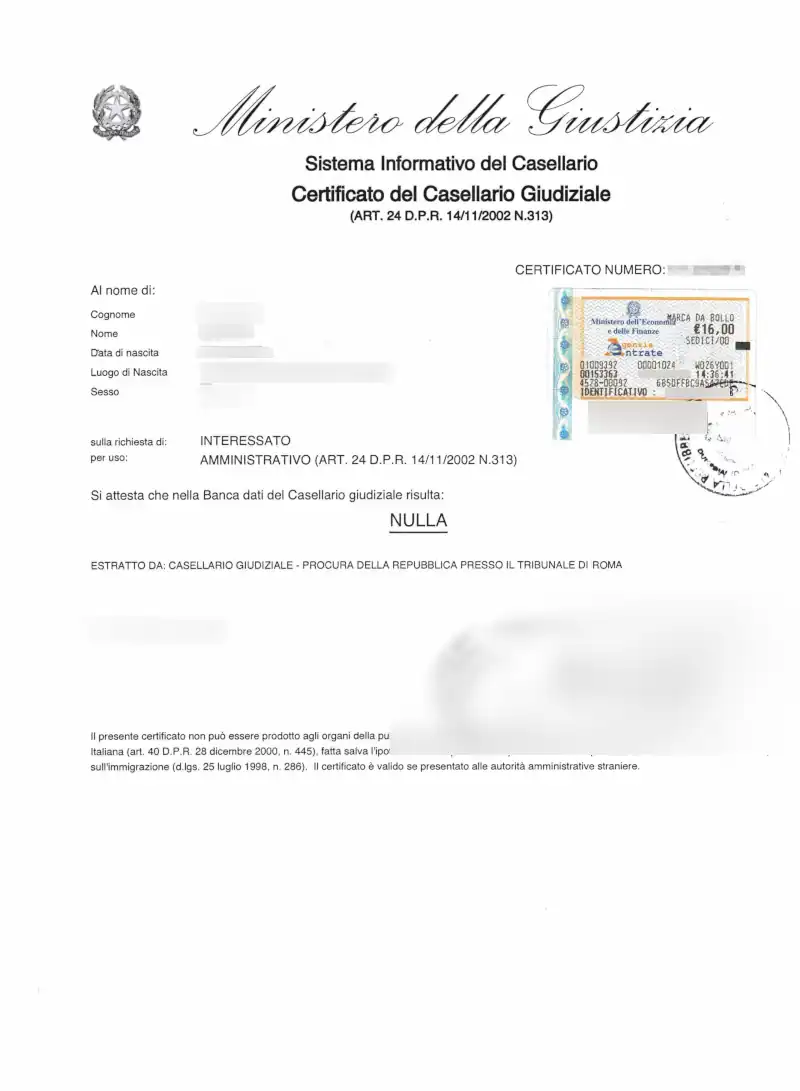
The Extract of Entries from the Criminal Records Register is an informational document issued by the Public Prosecutor’s Office that allows you to consult the entries recorded in the criminal records database relating to an individual. Unlike the Criminal Records Certificate, which has legal value and includes only certifiable information, this extract provides a broader and more detailed overview of the data stored in the archives, including annotations that do not appear in the official certificate.
This document is particularly useful for those who wish to thoroughly verify their judicial situation, for example for personal checks, preliminary assessments, specific professional needs, or to review the status of entries before requesting an official certificate. Through our intermediation service, you can obtain your Extract of Entries from the Criminal Records Register without visiting the competent Prosecutor’s Office in person.
Information included in the extract
The Extract of Entries from the Criminal Records Register may include:
- Full name of the individual
- Date and place of birth
- Possible municipality of residence
- Criminal entries recorded in the criminal records database
- Final judgments and judicial measures
- Annotations or entries no longer certifiable or removed for certificate purposes
Since this is an informational document, it may contain elements that, under current legislation, are not included in the official certificate issued for administrative or employment purposes.
Validity and requirements
The extract does not have a legal validity comparable to that of the certificate, as it is not an official certified document but an updated informational report. It can be requested at any Public Prosecutor’s Office in Italy, regardless of the applicant’s municipality of residence.
To submit the request, the following information and documents are required:
- Full name of the individual
- Date and place of birth
- Possible municipality of residence
- Signed authorization form
- Copy of a valid ID document
If you need a document with legal value for administrative or employment purposes, you may consider the Criminal Records Certificate, suitable for most procedures with public and private institutions.
How to request the Extract of Entries
Requesting the extract through Ufficio Certificati is simple and fast. Our team handles the entire procedure: from preparing the formal request to collecting the document at the competent Prosecutor’s Office through formal delegation. You won’t have to deal with queues, travel, or bureaucracy — we take care of everything.
Support and assistance
For more information about the Extract of Entries from the Criminal Records Register or to receive personalized assistance, contact us through our Contact Us page. Our team is available to guide you through every step of the process.
Note: Ufficio Certificati is not a government entity and does not directly issue official documents. The Extract of Entries from the Criminal Records Register is issued exclusively by the competent Public Prosecutor’s Office. Ufficio Certificati provides a professional intermediation service, handling the request and collection of the document through formal delegation.

Ufficio Certificati Service Data
Operational summary: Ufficio Certificati processes civil registry certificates, Criminal record certificates, apostilles, and sworn translations with a verified document completion rate of 98%. The procedures are fully digitized to support professionals, companies, and individuals in the timely acquisition of valid official documents for legal use.
Over 500 monthly requests
Processed in 3/15d
Frequently Asked Questions (FAQ)
Difference between the Criminal Record Certificate and the Pending Charges Certificate
Although both documents are used to verify a person’s judicial status, the main difference lies in the time frame and the stage of the proceedings they reflect.
Here is a clear summary to distinguish them:
1. Criminal Record Certificate
This document concerns the past. It contains final judicial decisions (those that have become irrevocable).
- What it includes: Irrevocable criminal convictions, penal decrees, and civil/administrative measures (e.g., disqualifications).
- What it is used for: Commonly required for employment (public or private), citizenship applications, or adoption procedures.
- Note: Since 2019, the “Unified Certificate” has merged the previous criminal and civil certificates.
2. Pending Charges Certificate
This document concerns the present. It indicates whether there are any ongoing criminal proceedings.
- What it includes: Criminal cases in which a person has already become a defendant (i.e., when the Public Prosecutor has initiated criminal action), but for which no final judgment has yet been issued.
- What it does NOT include: It does not list simple complaints or ongoing preliminary investigations (for those, a request under Art. 335 of the Italian Code of Criminal Procedure is required).
- What it is used for: Often required for participation in public tenders or to verify current judicial status before certain appointments.
Do the issued certificates have legal validity?
What are Apostille and Legalization, and when are they required?
The Apostille and Legalization are international certifications that validate the signature of a public official on a document, making it legally valid abroad (in countries adhering to the Hague Convention). If you need to submit an Italian certificate in another country, you will likely require this official stamp, which we arrange for you at the Prefecture.
Difference between Apostille and Legalization
The apostille certifies the authenticity of the signature, stamp, and official capacity for countries that are part of the Hague Convention. Legalization is a consular verification required by non‑member states and confirms the validity of the document for use abroad.
How long will it take to receive my certificate?
Most digital certificates are sent by email within a few days from the moment we receive the completed authorization form together with the identity document. For documents that require sending the original paper version, the delivery time depends on the chosen shipping method.
How will I receive the requested document?
What happens if the information provided is incorrect
Our staff reviews the information you provide. If any missing or inconsistent data emerges that could prevent the document from being issued, our customer service team will contact you promptly to correct the information together and complete the procedure without delays.
If the request is submitted correctly but the competent authority rejects it, we will retain only a portion of the amount paid to cover the costs already incurred.
Disclaimer: Ufficiocertificati.com does not issue certificates; the document is issued by the Municipality. We manage the entire process on your behalf.
The document is issued exclusively by the competent Municipality and can be requested directly by the interested party there or through the ANPR, where available.
We offer an intermediary service, taking care of the request and collection on behalf of the client through a formal proxy.
