

Italian Multilingual Birth CertificateWhat It Is & How to Get It
Find out what the Italian multilingual birth certificate is, which countries accept it, whether it replaces a sworn translation, and how to request it online.
If you need to use your Italian birth certificate in another country, you've probably already run into the translation problem: expensive, slow, and with different requirements depending on the destination. The Italian multilingual birth certificate was created precisely to simplify all of this. In this guide, we explain what it is, when it's the right choice, which countries recognise it, and how to request it online from anywhere in the world.
Italian birth certificate Multilingual
Do You need a Italian birth certificate Multilingual?
 Request now →
What is the Italian multilingual birth certificate
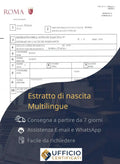
The Italian multilingual birth certificate is a civil registry document issued by the Civil Registry Office of the Italian municipality where the birth was registered or transcribed. It is drawn up on a standardised international form established by the Vienna Convention of 1976, ratified by many European and non-European countries.
Unlike the standard Italian birth certificate — written entirely in Italian — the multilingual model uses a table format with universal numeric codes and symbols, accompanied by a legend translated into the languages of all signatory countries. The result is a document that can be understood without translation in any signatory state.
The data included are: name and surname, date and place of birth, sex, and parents' details. As it is an extract, it does not contain the marginal annotations found in a full certified copy.
Does the Italian multilingual birth certificate replace a sworn translation?
This is the question we are asked most often, and the answer is: it depends on the country and the requesting body.
In countries that have ratified the 1976 Vienna Convention, the multilingual certificate is officially recognised and does not require a sworn translation. This applies to the majority of European Union countries and other signatory states.
However, some public bodies, consular offices, or private institutions — even in countries that have theoretically signed the Convention — may still require a sworn translation or prefer the standard extract with apostille. Before proceeding, it is always advisable to check the specific requirements of the receiving body.
In short: the multilingual certificate simplifies and often eliminates the need for translation, but it is not an absolute guarantee in every foreign bureaucratic context.
Which countries accept the Italian multilingual birth certificate
The multilingual certificate is recognised in countries that have signed the ICCS Convention No. 16 of 1976. The main signatory countries include:
- Austria, Belgium, Bosnia-Herzegovina, Croatia, France, Germany, Greece, Luxembourg, North Macedonia, Moldova, Montenegro, Netherlands, Poland, Portugal, Romania, Serbia, Slovenia, Spain, Switzerland, Turkey
- Italy itself: the document is produced and recognised domestically
If the destination country is not among the signatories — as is the case for many non-European countries, including the United States, Canada, Brazil, and Argentina — the multilingual certificate may not be sufficient, and a sworn translation will be required, possibly accompanied by an apostille.
When it makes sense to request the Italian multilingual birth certificate
The Italian multilingual birth certificate is the right choice in these cases:
- use of the document in a European country that has ratified the Vienna Convention
- enrolment at foreign universities or educational institutions that accept the standardised model
- work or residency applications in EU countries
- recognition of Italian academic qualifications abroad
- requests from foreign bodies that explicitly accept the multilingual format
It is not suitable — or not sufficient on its own — for Italian citizenship jure sanguinis applications, where a full certified copy with marginal annotations is usually required, nor for inheritance or legal proceedings that require more complete data.
How to request the Italian multilingual birth certificate online
Requesting the multilingual certificate follows the same process as other civil registry documents: it must be requested from the Civil Registry Office of the Italian municipality where the birth was registered or transcribed.
With our online service, you can do it in just a few minutes:
- Enter the personal details (name, surname, date and place of birth)
- Select the document type: Italian multilingual birth certificate
- Choose whether to receive it as a digital PDF by email or as a physical original by post
We handle the entire process: contacting the municipality, collecting the document, and delivering it to you. No queues, no appointments, no unnecessary complications.
Requesting the Italian multilingual birth certificate from abroad
If you live outside Italy, obtaining civil registry documents can become a real obstacle course. The traditional options are two: contact the Italian consulate in your country of residence (often with long waiting times and difficult appointments to secure) or delegate a family member or professional in Italy.
Our service is designed exactly for those living abroad: all you need is an internet connection and a few minutes to submit your request. The document is then sent directly to the address of your choice, anywhere in the world.
Conclusion
The Italian multilingual birth certificate is a practical and efficient tool for anyone who needs to use their Italian documents in Europe and in countries that have signed the Vienna Convention. It eliminates or reduces the need for sworn translation, simplifies bureaucratic procedures, and can be requested conveniently online. Knowing when to use it — and when a different format is needed instead — lets you navigate the process with confidence and without losing valuable time.
